Inform
Provide clear election information, public issue awareness, and practical civic education.
Alpha Phi Alpha Fraternity, Inc.® | Theta Zeta Lambda Chapter
TZL Empower connects civic education, voter engagement, community dialogue, neighborhood outreach, and responsible public participation in one clear community impact strategy.
Mission, purpose, and VPHP connection
TZL Empower is the official civic engagement initiative of Alpha Phi Alpha Fraternity, Inc.®, Theta Zeta Lambda Chapter and the chapter's local delivery pathway for A Voteless People Is a Hopeless People (VPHP).
The initiative strengthens communities through voter registration, voter education, public-policy awareness, civic participation, neighborhood outreach, and community engagement across Washtenaw County and Western Wayne County.
Provide clear election information, public issue awareness, and practical civic education.
Create forums, workshops, outreach experiences, and community conversations that welcome participation.
Prepare residents to understand their voice, make informed decisions, and participate with confidence.
Use accurate information, respectful communication, transparent practices, and a consistent nonpartisan standard.
Empower does not endorse or oppose political parties or candidates. Public education is factual, balanced, respectful, and accessible; candidate or public-official participation is structured for community education rather than campaign promotion; and residents are encouraged to research, ask questions, and make their own informed decisions.
How Empower strengthens community voice
Empower moves residents and volunteers from awareness to sustained community leadership through a connected six step model.
Review local needs, population trends, public issues, precinct data, and barriers to participation.
Share clear information about registration, voting options, public offices, ballot questions, and community decisions.
Work with schools, faith organizations, neighborhood groups, nonprofits, businesses, and local institutions.
Use registration drives, neighborhood outreach, digital education, forums, and public events to connect with residents.
Promote early voting, share election reminders, reduce participation barriers, and encourage informed action.
Evaluate turnout, registrations, households reached, partnerships, volunteer activity, and precinct progress.
Corrected service area framework
Empower uses real local-government boundaries as the organizing standard, then groups municipalities into service regions for leadership, data review, outreach planning, and accountability.
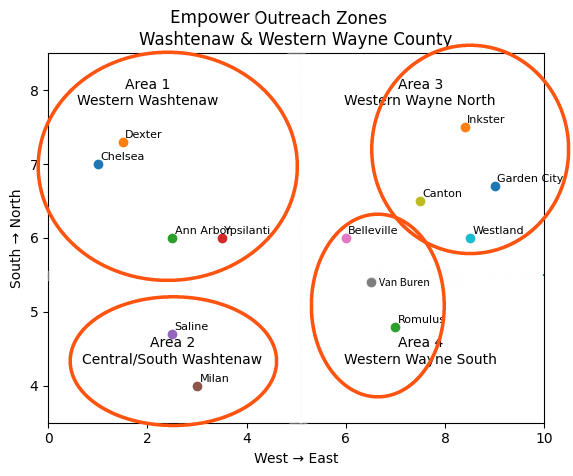
Communities: Ann Arbor, Ann Arbor Township, Barton Hills.
Objective: Increase civic participation among mobile populations while maintaining strong engagement among students and young professionals.
Outreach: University, college, neighborhood, apartment-community, registration, early-voting, and ballot education.
Communities: Ypsilanti, Ypsilanti Township, Superior Township.
Objective: Increase voter participation while strengthening year-round civic education and public involvement.
Outreach: Faith and school connections, community centers, priority-precinct education, and canvassing.
Communities: Saline, Saline Township, Pittsfield Township, Lodi Township, Augusta Township, York Township, Milan, Bridgewater Township.
Objective: Track population growth and engage newly eligible and newly relocated voters.
Outreach: School and family networks, new-resident education, growing-neighborhood outreach, registration, and early-voting information.
Communities: Chelsea, Sylvan Township, Dexter, Dexter Township, Scio Township, Lima Township, Lyndon Township, Freedom Township, Sharon Township, Manchester, Manchester Township, Webster Township, Northfield Township, Salem Township.
Objective: Maintain strong voter participation and ongoing civic education across western and northern Washtenaw communities.
Outreach: Township information, community events, local partnerships, and continuous public-issue education.
Communities: Westland, Garden City, Inkster.
Objective: Identify precincts with low turnout and deploy targeted civic education and engagement strategies.
Outreach: Priority-precinct review, neighborhood outreach, and faith/community partner engagement.
Communities: Romulus, Belleville, Van Buren Township, Sumpter Township.
Objective: Engage new residents and increase participation across western Wayne south communities.
Outreach: New-resident outreach, growth-area engagement, and practical voting information.
Community: Canton Township.
Objective: Maintain strong civic engagement while supporting a rapidly growing community.
Outreach: School and neighborhood outreach, culturally responsive civic education, and partner-based community communication.
Research: review turnout data, population change, barriers, and outreach activity. Partnership: build local relationships with schools, faith groups, and community organizations. Outreach: conduct registration, public education, neighborhood engagement, and digital communication. Evaluation: measure contacts and attendance, review precinct progress, document lessons, and improve the next cycle.
Strategy and accountability
Empower combines community intelligence, precinct-level review, structured outreach, trusted partnerships, and measurable follow-through.
Track population growth, new housing developments, residents moving into communities, and local demographic shifts.
Track new registrations, young adults reaching voting age, student populations, and civic-education needs.
Review local issues, transportation and access barriers, language needs, and information gaps.
Maintain area-specific partner networks and verify municipal boundaries, precinct routes, polling information, election dates, and public resources before release.
Review turnout data, identify Priority Engagement Precincts, confirm partners and volunteers, and develop local outreach plans.
Conduct registration drives, increase workshops and public information, distribute education materials, and strengthen partner outreach.
Deploy canvassing and outreach teams, share voting options and deadlines, promote early voting, and address participation barriers.
Provide final reminders, share verified practical information, encourage informed participation, and support accessible outreach.
Review results, document lessons, recognize volunteers and partners, and strengthen the next engagement cycle.
Use approved teams and routes, remain in visible public areas, follow check-in procedures, and report concerns promptly.
No pressure, argument, partisan advocacy, entry into homes, or unauthorized photographs.
Use current approved materials, verify dates and locations, refer complex questions, and correct errors promptly.
Record route completion, track contacts consistently, protect private information, and submit materials on time.
2026-2027 strategic delivery plan
Empower combines year-round civic education, community outreach, volunteer development, and the April 24 ELMP Youth Town Hall into one measurable civic-learning strategy.
Civic education participants
Verified civic resource recipients
Community feedback responses
Increased civic understanding
Prospective volunteers
Youth Town Hall attendees
Esquires at Youth Town Hall
Esquires in active roles
Decision briefs / civic actions
Trained volunteers
Active civic partners
Nonpartisan review before public release
Major after-action reports completed within 14 days
Map and boundary review before service-area materials are published
Aug 27: CEI Community Partnership Luncheon - cross-pillar relationship and resource activation. Apr 24, 10 AM: ELMP Youth Town Hall - civic learning and youth leadership anchor.
Leadership and area team structure
Empower uses committee leadership, local area teams, and Community Focus Councils to coordinate research, education, outreach, communications, volunteers, municipal-boundary review, and community relationships.
Committee Chair: strategic leadership and oversight. Vice Chair: implementation and continuity. Data and Research: turnout, registrations, precinct analytics, municipal-boundary updates, and research tools.
Community Outreach: engagement, events, canvassing, and partners. Youth and New Voter: youth and first-time-voter education. Communications: messaging and public information. Volunteer: recruit, train, schedule, support, and document volunteers.
Area Lead, Area Data Coordinator, Area Outreach Coordinator, Volunteer Coordinator, and Community Liaison provide geographically organized leadership and local accountability.
High school seniors, college students, newly registered voters, and first-time voters.
Churches, mosques, community organizations, nonprofit partners, and trusted local networks.
Senior residents, retirement communities, long-term residents, and accessible civic information.
Homeowners associations, parent organizations, neighborhood groups, and community-based outreach.
Candidate forums, public-issue discussions, community education events, and election information.
ELMP, youth civic ambassadors, research and public speaking, and supervised community service.
Resources, partnerships, and quality
The current packet includes the corrected seven-area framework, strategic scorecards, operating calendar, partnership strategy, and quality standards.
Prepared guidance and materials for safe, respectful, nonpartisan neighborhood engagement.
An additional civic education resource to help residents prepare for informed participation.
Verified voter resources, public-policy education, election information, accessible materials, presenters, and subject-matter expertise.
Meeting space, audiovisual support, printing, technology, transportation, accessibility, registration, and event logistics.
Volunteer recruitment and training, neighborhood outreach, faith and school connections, resident invitations, and follow-up.
Precinct and community research, evaluation support, in-kind contributions, sponsor introductions, grant development, and approved financial support.
Local liaisons and partners assigned to one or more service areas so outreach is geographically organized and accountable.
No candidate or party endorsement; balanced educational formats; equal respect for resident choices; clear separation from campaign activity.
Use official sources and verify dates, locations, offices, voting options, links, maps, public resources, and municipal groupings.
Collect only approved information, limit access, protect resident data, and report aggregate results when appropriate.
Use trained volunteers, clear roles, approved materials and routes, safe practices, supervised youth participation, and timely follow-up.
Submit monthly updates, review quarterly, document corrective action for at-risk goals, and complete major after-action reports within 14 days.
Verify logos, maps, contacts, links, QR destinations, service-area groupings, precinct routes, volunteer roles, safety, privacy, and final leadership approval.
Connect with TZL Empower
Educational institutions, community organizations, faith organizations, municipal governments, nonprofits, civic groups, businesses, and residents are welcome to connect. Financial contributions are processed through TZL Community & Education Initiative.
TZL Community and Education Initiative Tax ID: 81-1257797